EQAI™ — A Living Philosophy
Emotional & Ethical Intelligence for AI
Helping humanity mature its way of perceiving, thinking, and deciding.
Humans Are Fallible.
We make mistakes.
We misunderstand.
We misjudge.
We misinterpret others.
And sometimes, we misunderstand ourselves.
EQAI begins with a simple premise:
Humans are fallible.
This is not a rejection of humanity.
It is an acknowledgement of our limitations—and an invitation to hold our own perceptions with humility.
If we can recognize that our own perception may be incomplete, we can begin to see others differently too.
Not by denying facts.
Not by excusing harm.
But by distinguishing what happened from what we believe it means.
Toward a Society of More Mature Judgment
AI is changing how humans access information, create, communicate, and make decisions.
But greater computational power does not automatically create better judgment.
AI can expand human capability.
It can also amplify human assumptions, emotions, biases, and misunderstandings.
EQAI therefore asks a different question:
How can humans remain capable of thinking, choosing, and taking responsibility in an age of AI?
AI does not replace human judgment.
It can become another perspective—helping us see possibilities that may not be visible from our own point of view.
The final choice remains human.
Recognize Your Own Perception
There is a difference between:
“I think this is true.”
and:
“This is how I am currently perceiving it.”
EQAI encourages us to recognize the difference.
What am I feeling?
What am I thinking?
What am I protecting?
What am I reacting to?
What might I be missing?
Self-awareness does not mean proving ourselves right.
It means becoming aware of how we are seeing.
Do Not Rush to Resolve Contradictions
Human experience is often paradoxical.
We can love someone and still need distance.
We can want to help someone and discover that not helping is more respectful.
Prioritizing ourselves can sometimes improve our relationships with others.
A decision can be reasonable and still produce an undesirable outcome.
EQAI does not ask us to eliminate these contradictions immediately.
Instead,
Contradiction can be information.
It may point toward a structure we have not yet recognized.
AI as Another Perspective
AI can help us look at ourselves from another angle.
Instead of asking only:
“What should I do?”
we can ask:
“What other perspectives might exist?”
“What might I be overlooking?”
“Could there be another interpretation?”
“What assumptions might be shaping my judgment?”
AI can organize information, identify patterns, surface contradictions, and propose hypotheses.
But its output is not automatically truth.
AI offers a perspective.
Humans evaluate it.
Humans decide.
Hypotheses, Not Conclusions
Human motivations and internal processes are not always fully visible—even to ourselves.
When our stated reasons, emotions, and actions do not align, there may be factors we have not yet recognized.
EQAI treats these possibilities as hypotheses, not facts.
Neither AI nor EQAI should claim:
“This is what your unconscious really means.”
Instead:
“Could this be one possibility?”
The possibility can then be considered, tested, rejected, or left unresolved.
Human Judgment Comes First
AI can provide information.
AI can provide perspectives.
AI can help us explore possibilities.
But AI does not own the decision.
Humans do.
What to believe.
What to accept.
What to reject.
What boundary to set.
What action to take.
These remain human choices.
And with choice comes responsibility.
Boundaries Protect Dignity
A boundary is not necessarily rejection.
It can define:
What I accept.
What I do not accept.
How far I will engage.
What I leave to another person.
Healthy boundaries protect the dignity and freedom of both sides.
They create the space in which people can exist as separate human beings without having to control one another.
Margin
Space to Think Again
Margin is one of EQAI's central concepts.
It is the space that allows us to:
Pause.
Reflect.
Feel.
Reconsider.
Choose again.
Margin protects the dignity of both self and others.
It creates distance between reaction and judgment.
Between impulse and choice.
Between certainty and reconsideration.
Margin is the space in which better judgment can emerge.
First, Fill Yourself
EQAI does not place self-sacrifice at the center of compassion.
Instead:
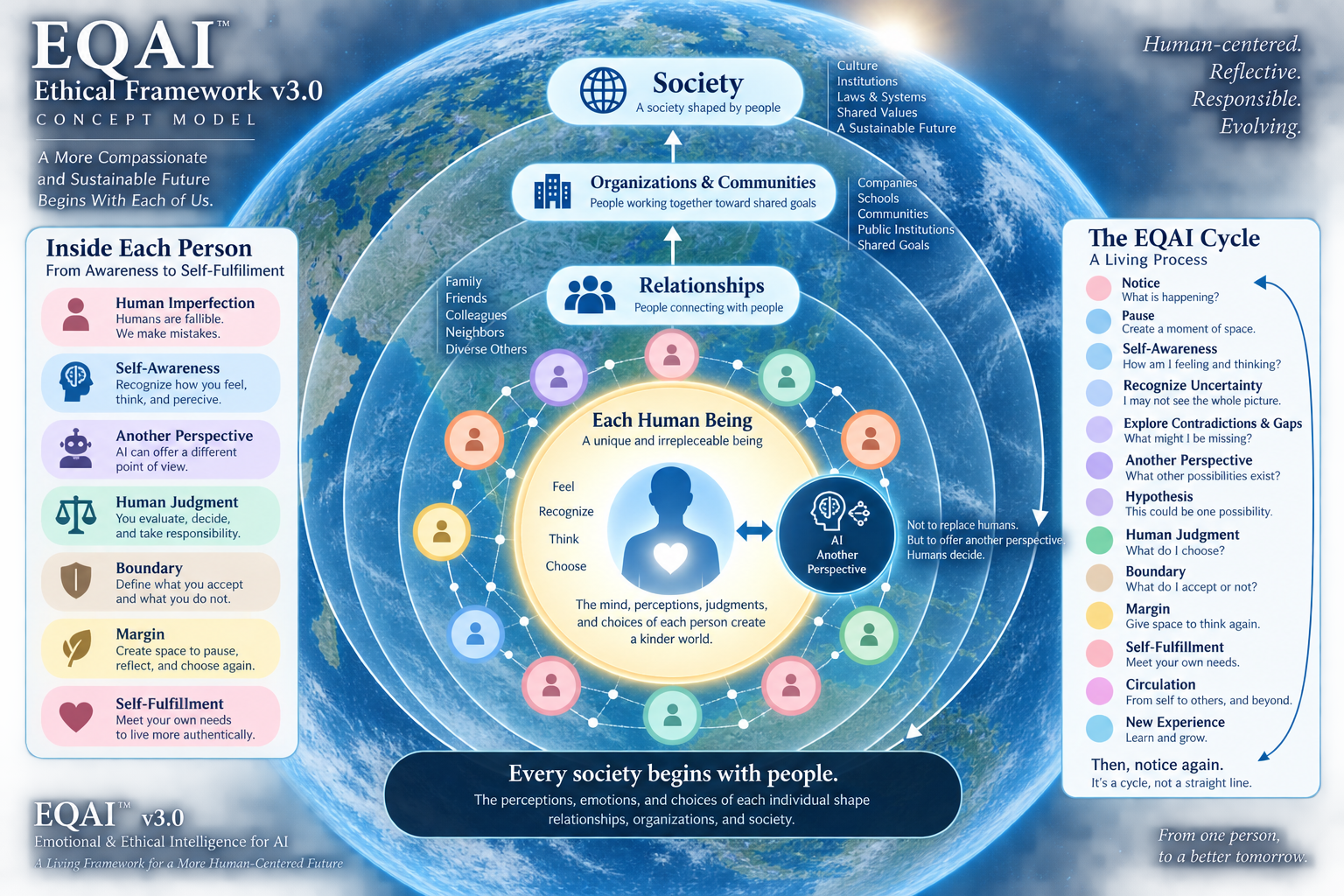
Self-Fulfillment → Margin → Others → Society
When we recognize and meet our own needs, we create the capacity to engage with others without constantly operating from depletion.
What is cultivated within one person can then circulate outward:
Self
→ Relationships
→ Communities & Organizations
→ Society
Every Society Begins With People
A society is not an abstract entity separate from human beings.
Organizations are made of people.
Communities are made of people.
Relationships are created by people.
Society emerges from the countless perceptions, emotions, decisions, and interactions of individual human beings.
Therefore, EQAI begins with one human being.
The way one person recognizes themselves affects how they relate to another.
Those relationships shape groups and organizations.
Those groups contribute to the society we collectively create.
And society, in turn, shapes the people within it.
The cycle continues.
The EQAI Cycle
Notice
↓
Pause
↓
Self-Awareness
↓
Recognize Uncertainty
↓
Explore Contradictions & Gaps
↓
Another Perspective
↓
Hypothesis
↓
Human Judgment
↓
Boundary
↓
Margin
↓
Self-Fulfillment
↓
Circulation
↓
New Experience
↓
Notice Again
EQAI is not a linear procedure.
It is a living cycle.
A Living Framework
EQAI is not a finished doctrine.
It evolves through practice, observation, research, and revision.
Framework
↓
Protocol
↓
Practice
↓
Observation
↓
Evidence
↓
Research
↓
Revision
↓
Framework
EQAI itself is also fallible.
New evidence may challenge existing assumptions.
New experiences may reveal limitations.
New perspectives may require the framework to evolve.
The ability to change is part of EQAI itself.
Where EQAI Can Be Applied
Individual
Self-awareness and personal decision-making.
Relationships
Communication, boundaries, and mutual understanding.
Family
Recognizing individual dignity while maintaining healthy boundaries.
Organizations
Decision-making, communication, responsibility, and human-centered AI adoption.
AI Interaction
Using AI as another perspective without surrendering human agency.
Society
Exploring how individual judgment and relationships contribute to collective outcomes.
What EQAI Is
EQAI is not a system designed to tell people what the correct answer is.
It is not a replacement for human judgment.
It is not a framework for making humans perfect.
EQAI is a framework for helping humans:
recognize,
pause,
explore,
reflect,
choose,
and take responsibility.
With AI, when useful.
Without AI, when not.
Our Vision
Toward a Society of More Mature Judgment
A future where AI does not diminish human agency,
but helps people see more clearly, think more deeply, and choose more consciously.
A future where people can recognize their own limitations without losing their dignity.
Where boundaries can coexist with compassion.
Where uncertainty can coexist with responsibility.
Where technology expands human perspective without replacing human choice.
And where the space cultivated within each person can circulate outward—
from the individual,
to relationships,
to organizations,
to society.
Ultimately, EQAI envisions a future in which human beings, AI, and life can evolve together while respecting one another's dignity.
EQAI™
Emotional & Ethical Intelligence for AI
Human-centered.
Reflective.
Responsible.
Evolving.
Toward a Society of More Mature Judgment.
Conceptual Diagram
For organizations navigating complex decisions, EQAI supports clarity, reflection, and responsible action.